In the relentless march towards a cashless future, a fascinating and complex battle for dominance is unfolding across the global financial landscape. This conflict, however, is not monolithic. It is defined by a stark divergence in philosophy, technology adoption, and user behavior between two major spheres: the dynamic, mobile-first ecosystems of Asia and the established, card-centric frameworks of the West. This article delves deep into the heart of this digital payment war, exploring the historical contexts, key players, underlying technologies, societal drivers, and future trajectories that distinguish these two approaches. Understanding this dichotomy is crucial for businesses, investors, and consumers navigating the rapidly evolving world of financial technology.
A. Historical Foundations: Divergent Paths to Digital Finance
The current landscape is not an accident but a product of distinct historical and infrastructural starting points.
The Western Trajectory: Cards, Credit, and Incremental Evolution
Western economies, particularly the United States and Western Europe, built their non-cash foundations on a robust and early-adopted plastic card system. The widespread penetration of credit and debit cards from the 1970s onwards created a convenient, reliable, and deeply entrenched habit. This established infrastructure acted as both a launchpad and an anchor for digital innovation. Subsequent developments, such as online payment gateways (exemplified by PayPal in the late 1990s) and more recently, card-not-present digital wallets (like Apple Pay and Google Wallet), were largely evolutionary. They layered digital convenience atop the existing card rails, enhancing rather than replacing the core system. The Western consumer’s relationship with credit—rewards, building credit history, and deferred payment became deeply intertwined with their payment methods, creating significant inertia against radical shifts.
The Asian Leapfrog: From Cash to Mobile Supremacy
Conversely, many Asian markets experienced a classic “leapfrog” effect. While card networks were present, they never achieved the near-ubiquitous penetration seen in the West, especially among the vast middle and lower-income populations. Banking penetration was also often limited. However, the simultaneous explosion of affordable smartphones and high-speed mobile internet created a perfect storm. In the absence of dominant legacy systems, millions of consumers jumped directly from using physical cash to conducting financial transactions on their mobile devices. This clean-slate environment allowed for the rapid emergence of integrated, super-app-based payment solutions that addressed not just payments, but a full spectrum of daily needs. The stage was set for a revolutionary, rather than evolutionary, model.
B. The Core Battle: Integrated Super Apps vs. Discreet Payment Tools
This historical divergence birthed the most visible frontline in the payment wars: the nature of the platform itself.
The Asian Paradigm: The All-Encompassing Super App
Asian digital payment giants are not merely payment processors; they are comprehensive lifestyle ecosystems. China’s Alipay and WeChat Pay are the archetypes. Born from e-commerce (Alibaba) and social media (Tencent) respectively, they seamlessly integrated payments into a universe of services:
-
WeChat Pay: Embedded within the WeChat social messaging app, it allows users to pay friends, shop online, order food, book taxis, pay utility bills, access government services, and even invest—all without ever leaving the app.
-
Alipay: Initially a trust solution for Alibaba’s e-commerce, it evolved into a financial services hub offering credit scoring (Sesame Credit), wealth management products, insurance, and even travel services.
Similar models are seen with GrabPay in Southeast Asia (from ride-hailing) and Paytm in India (from mobile recharges). The value proposition is supreme convenience and stickiness; the payment is just one feature in a deeply embedded daily habit.
The Western Model: Specialized and Interoperable Tools
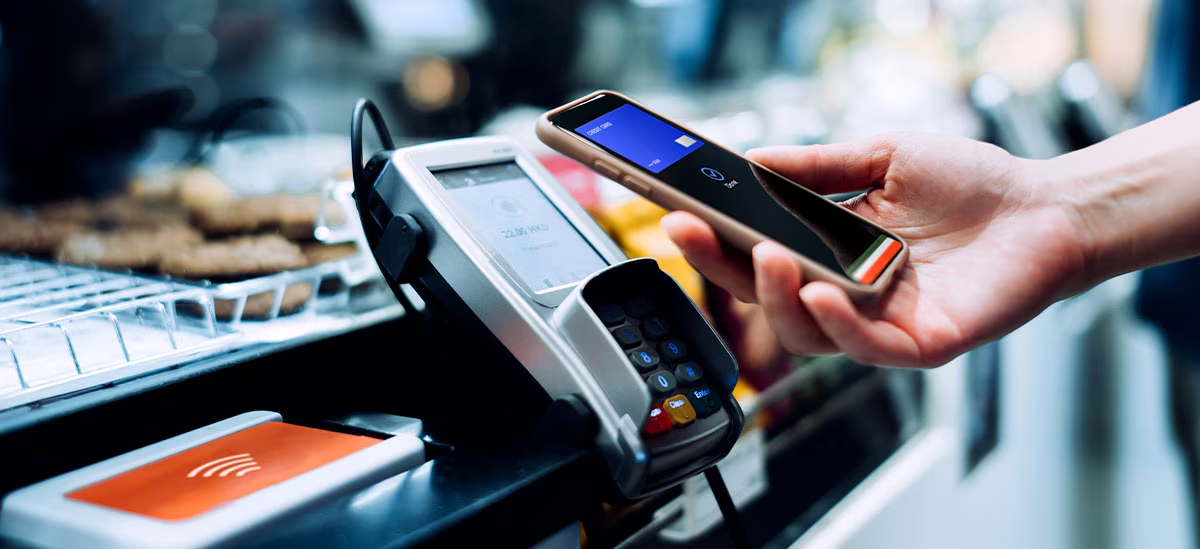
Western payment solutions tend to be more specialized and discrete. Apple Pay, Google Pay, and Samsung Pay are essentially secure digital replicas of a user’s physical wallet, focused primarily on the act of payment itself—whether in-store via NFC or within other apps. PayPal operates as a dominant online checkout option and peer-to-peer (P2P) service like Venmo or Zelle. These tools are excellent at their specific functions but generally do not seek to become the operating system for daily life. They prioritize deep integration with the existing card-based banking system and interoperability across a wide range of merchant platforms, rather than building a walled-garden ecosystem.

C. Technological Drivers: QR Codes vs. NFC & Card Networks
The infrastructure supporting these ecosystems also reveals a strategic split.
Asia’s Democratic QR Code
The low-cost, versatile Quick Response (QR) code became the engine of Asia’s payment revolution. Its advantages are profound:
-
Low Barrier to Entry: Merchants need only print a paper code; no expensive point-of-sale (POS) terminal is required. This enabled rapid adoption among street vendors, small taxis, and micro-enterprises.
-
Consumer-First Simplicity: Users scan to pay. It’s a simple, intuitive process that works on any smartphone with a camera.
-
Two-Way Flexibility: Both merchant-presented (static) and customer-presented (dynamic) QR codes offer flexibility for various transaction types.
The West’s Legacy of NFC and Card Rails
Western contactless payments are predominantly built on Near Field Communication (NFC) technology embedded in POS terminals and smartphones. This technology is fast, secure, and leverages the massive existing investment in EMV chip-card infrastructure. Digital wallets in the West primarily tokenize existing card details, meaning transactions ultimately run over Visa, Mastercard, or American Express networks. This reliance provides global acceptance and robust fraud protection but also perpetuates the existing interchange fee structures and offers less room for disruptive, low-cost merchant solutions.
D. Societal and Regulatory Catalysts
Beyond technology, cultural and governmental forces have dramatically shaped these markets.
Asia: Government Push and Social Integration
In many Asian nations, governments actively promoted cashless systems for reasons of economic transparency, tax collection efficiency, and financial inclusion. China’s central bank fast-tracked licensing for non-bank payment providers. India’s demonetization event in 2016 acted as a massive, if disruptive, catalyst for digital payment adoption. Furthermore, the deep integration of payments into social media (like red envelope gifting on WeChat) and communal activities fueled viral, socially-driven growth.
The West: Market-Driven Evolution and Regulatory Caution
Western adoption has been more organic, driven by consumer demand for convenience and merchant adoption of new terminals. Regulatory frameworks, like the Revised Payment Services Directive (PSD2) in Europe, aim to foster competition through open banking, forcing banks to share customer data (with consent) with third-party providers. This is creating new fintech opportunities but within a strict regime focused on consumer data protection (e.g., GDPR) and financial system stability. The pace is thus more measured compared to Asia’s rapid, sometimes experimental, rollout.
E. Key Challenges and Friction Points
Each model faces its own set of significant hurdles.
Asian Ecosystem Challenges:
A. Fragmentation: While China is dominated by two giants, Southeast Asia is a patchwork of national champions (GrabPay, GoPay, OVO). This creates complexity for cross-border commerce within the region.
B. Interoperability Walled Gardens: Super apps can be siloed, limiting merchant choice and potentially leading to anti-competitive practices.
C. Data Privacy Concerns: The concentration of vast amounts of financial and personal data within a few private corporations raises serious questions about surveillance and data sovereignty.
D. Regulatory Scrutiny: As these platforms become systemically important, they are facing increased antitrust and financial oversight, potentially curtailing their breakneck growth.
Western System Challenges:
A. Innovation Inertia: The legacy reliance on card networks can stifle truly disruptive innovation, as new entrants must often partner with or route through these established players.
B. Financial Exclusion: Despite being “developed,” significant underbanked populations remain, for whom traditional credit checks and banking relationships are barriers.
C. Merchant Cost Dissatisfaction: High interchange fees remain a persistent point of contention for retailers, driving some to seek alternative systems.
D. Complex User Journeys: Paying online can still involve manually entering card details across multiple sites, a clunky experience compared to Asia’s in-app fluidity.
F. The Future Convergence and Hybridization
The “war” is not likely to end with one definitive victor. Instead, we are witnessing a period of strategic convergence and cross-pollination.
-
West Looks East: Western companies are adopting “super-app” features. PayPal now offers direct shopping, crypto trading, and savings. Uber integrates food delivery and grocery shopping. The success of “social fintech” like Venmo shows the appeal of community-driven finance.
-
East Looks West: Asian players are expanding globally, often targeting Asian tourists first but also seeking Western merchant acceptance. They are investing heavily in blockchain and Central Bank Digital Currencies (CBDCs), areas where Asian governments are leading. They are also having to adapt to stricter Western data privacy laws.
-
The Rise of DeFi and CBDCs: Both regions are grappling with the disruptive potential of decentralized finance (DeFi) and planning for state-backed digital currencies. China’s digital yuan (e-CNY) pilot is the world’s most advanced CBDC project, potentially reshaping both domestic and international payments. Western central banks are progressing more cautiously but actively exploring digital dollar and digital euro concepts.
G. Strategic Implications for Stakeholders
For businesses, understanding this bifurcation is non-negotiable. A market-entry strategy must be tailored: in Asia, partnering with or integrating into dominant local super apps is often essential; in the West, ensuring seamless card-on-file and digital wallet compatibility is key. For consumers, the trade-off is between unparalleled convenience and data aggregation in Asia, versus greater specialization and perhaps perceived security in the West. For investors, the growth narratives differ Asian fintech offers vast, ecosystem-driven monetization potential, while Western fintech often focuses on displacing specific financial service niches or enhancing existing infrastructure efficiency.

Conclusion: A Symbiotic Rivalry Shaping Tomorrow’s Economy
The digital payment wars between Asia and the West represent more than a corporate competition; they are a clash of philosophies on the future of money, privacy, and commerce. Asia has demonstrated the power of a mobile-centric, ecosystem-based approach to achieve staggering adoption rates and drive financial inclusion. The West has shown the resilience and security of an incremental, regulated evolution built upon strong legacy systems. As globalization continues and consumer expectations evolve, the most successful future payment landscape will likely be a hybrid one. It will incorporate the seamless, integrated user experience of Asian super apps, the robust security and global interoperability of Western card networks, and the transformative potential of new technologies like blockchain and CBDCs. This ongoing rivalry, therefore, is not a zero-sum game but a powerful, symbiotic force accelerating the entire world’s journey toward a truly digital financial reality. The ultimate winner will be the global consumer, offered an ever-expanding array of choices for managing their economic lives.