The digital landscape rests upon a fragile foundation of mathematical complexity. For decades, the bedrock of our cybersecurity the encryption protocols safeguarding everything from global financial transactions and state secrets to personal emails and medical records has relied on problems too difficult for classical computers to solve in any reasonable timeframe. This silent, algorithmic war has maintained a precarious balance. However, a seismic shift is brewing in the laboratories of tech giants, governments, and research institutions worldwide. The nascent but rapidly advancing field of quantum computing promises not just a leap in computational power, but a direct assault on the very principles of modern cryptography. This impending revolution has ignited profound cybersecurity fears, pushing the global community into a race not merely for technological superiority, but for the very survival of data privacy and national security in the coming quantum age.
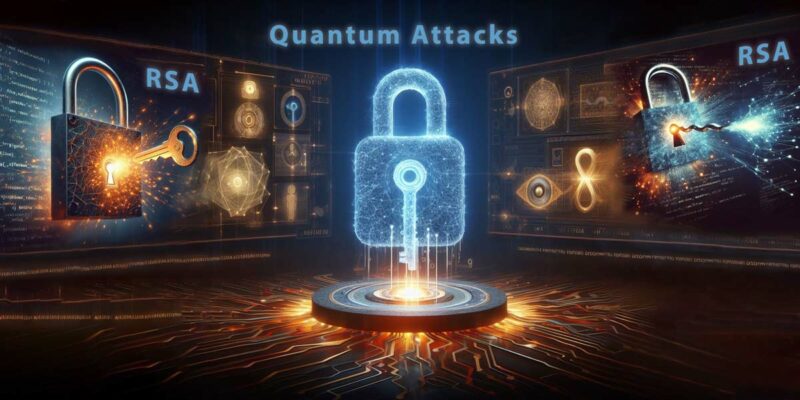
Quantum computing operates on principles fundamentally alien to classical computing. While classical computers use bits (0s and 1s), quantum computers use quantum bits or qubits. A qubit’s power lies in quantum superposition (the ability to exist in multiple states simultaneously) and entanglement (a powerful correlation between qubits that transcends distance). These properties allow a quantum computer to explore a vast number of possibilities in parallel. For certain, highly specific types of problems, this translates to exponential speedups. The most notorious of these problems, for cybersecurity, are the integer factorization and discrete logarithm problems the very mathematical pillars supporting the RSA and ECC (Elliptic Curve Cryptography) encryption schemes that secure the internet.
The term “Cryptographically Relevant Quantum Computer” (CRQC) defines a machine with enough stable, error-corrected qubits to run Shor’s algorithm a quantum algorithm devised in 1994 practically. A large-scale CRQC could break RSA-2048 encryption in hours or days, a task that would take the most powerful classical supercomputers billions of years. This is not a gradual erosion of security; it is a sudden and total collapse. The specter of “Q-Day” the day a CRQC becomes operational haunts intelligence and cybersecurity agencies. The threat is compounded by the “Harvest Now, Decrypt Later” strategy. Adversaries with long-term objectives are likely already collecting and stockpiling encrypted data of immense value (classified communications, intellectual property, personal identifiers), banking on the future ability to decrypt it once a quantum computer is available. This makes the threat not just future-oriented, but alarmingly present.
The cybersecurity domains facing existential quantum threats are vast and critical. The impact will be felt across every layer of our interconnected world.
A. Financial Systems and Digital Currencies
Global banking, stock exchanges, and payment gateways rely on TLS/SSL protocols using RSA or ECC. A breach would allow for the manipulation of transactions, the theft of vast wealth, and the undermining of economic stability. Furthermore, cryptocurrencies like Bitcoin and Ethereum, which use ECC for digital signatures to authorize transfers, are directly vulnerable. The entire blockchain premise of security could be undone, leading to catastrophic theft and loss of trust.
B. Government, Military, and Critical Infrastructure
Classified diplomatic and military communications have long shelf-lives. Secrets that must remain protected for decades are now at risk. The command-and-control systems for power grids, water treatment facilities, and transportation networks are increasingly networked and protected by classical encryption. A quantum attack could disable these systems, leading to societal chaos and posing a grave national security threat.
C. Healthcare and Personal Data
Patient health records, genomic data, and medical research are highly sensitive and lucrative targets. The large-scale decryption of such data would represent an unprecedented privacy catastrophe, enabling blackmail, discrimination, and intellectual property theft on a massive scale.
D. The Internet of Things (IoT) Ecosystem
Billions of connected devices from smart home gadgets to industrial sensors often have weak security today. Their upgrade cycle is long, and many will remain in the field for years. These devices, securing everything from home cameras to city traffic lights, will become glaring vulnerabilities in a post-quantum world if not prepared.
Recognizing the severity of this threat, a global effort is underway to develop and standardize Post-Quantum Cryptography (PQC). Also called quantum-resistant cryptography, PQC refers to new cryptographic algorithms designed to run on classical computers but are secure against both classical and quantum attacks. They are based on mathematical problems believed to be hard even for quantum computers, such as lattice-based cryptography, hash-based cryptography, code-based cryptography, and multivariate cryptography.
The U.S. National Institute of Standards and Technology (NIST) has been leading a multi-year international process to standardize PQC algorithms. After several rounds of scrutiny by the global cryptographic community, NIST has selected the first suite of algorithms. The primary standard for general encryption and key establishment will be CRYSTALS-Kyber, a lattice-based scheme. For digital signatures, the standards are CRYSTALS-Dilithium, FALCON, and SPHINCS+. This standardization is a critical step, providing a blueprint for the industry-wide migration that must follow.
Migration to a quantum-secure framework is a monumental, decade-long undertaking, often described as the most complex cybersecurity transition in history. It is not a simple software patch. The challenges are profound and multifaceted.
A. Legacy System Integration
Countless legacy systems in government and industry are deeply embedded, poorly documented, and run on outdated hardware. Upgrading or replacing these systems without causing catastrophic operational failure is a Herculean task requiring immense planning and investment.
B. Performance and Overhead
Some PQC algorithms have larger key sizes, signature lengths, or require more computational power than their classical predecessors. This can impact performance in constrained environments like IoT devices, satellite communications, or high-traffic web servers. Optimization and hybrid approaches (combining classical and PQC) are active areas of development.

C. The Crypto-Agility Imperative
The lesson from past cryptographic breaks is that algorithms can fall unexpectedly. Therefore, systems must be built with crypto-agility the ability to swiftly replace cryptographic algorithms and protocols without needing to overhaul the entire system architecture. This requires foresight in software and protocol design today.
D. Global Coordination and Standardization
The internet is global, and a patchwork of incompatible quantum-resistant standards would create fragility. While NIST’s process is leading, other countries are advancing their own research. Ensuring interoperability and widespread, coordinated adoption is a diplomatic and logistical challenge equal to the technical one.
E. Timeline Paradox and Strategic Advantage
The exact timeline for a CRQC is uncertain, with estimates ranging from a decade to several decades. However, the migration will take at least 10-15 years for critical infrastructure. Starting too late is a catastrophic gamble. The nation or entity that achieves quantum supremacy first will hold a “Sputnik moment” advantage, with the ability to decipher the world’s historical secrets while protecting its own.
While PQC is the primary defense, another quantum technology offers a different kind of solution: Quantum Key Distribution (QKD). QKD uses the principles of quantum mechanics (specifically, the fact that measuring a quantum state disturbs it) to securely distribute encryption keys. If an eavesdropper tries to intercept the key, their presence introduces detectable errors, alerting the communicating parties. The keys generated can then be used with “one-time pad” encryption, which is provably secure. However, QKD has significant limitations: it requires specialized hardware (often fiber-optic lines or line-of-sight satellite links), has range limitations without trusted nodes, and secures only key distribution, not the entire communication protocol. It is seen as a complementary, niche technology for ultra-high-security links rather than a wholesale replacement for internet-wide software-based cryptography.
The strategic response must be layered, urgent, and sustained.
A. Inventory and Risk Assessment
Every organization must begin by conducting a cryptographic inventory. What systems hold sensitive data with a long shelf-life? What encryption protocols and algorithms are in use? This discovery phase is essential to understanding vulnerability exposure.
B. Develop a Migration Roadmap
Based on the inventory, organizations must prioritize systems and create a phased migration plan. Systems involved in long-term data protection (e.g., document signing, data archives) and critical infrastructure should be prioritized. The plan must include budget, training, and procurement strategies.
C. Engage in Pilot Projects and Testing
Waiting for final standards to be ubiquitous is a mistake. Organizations should begin piloting PQC solutions in less critical systems, testing for performance impacts and integration issues. Major tech companies are already integrating PQC into test versions of browsers and platforms.
D. Demand Quantum-Resilience from Vendors
Procurement policies must be updated. Enterprises and governments should start requiring vendors to articulate their PQC migration strategy and offer crypto-agile solutions.
E. Support Research and Education
Sustained investment in quantum computing, PQC, and related fields is a national security imperative. Simultaneously, training a workforce of quantum-aware cybersecurity professionals is critical to managing this transition.
The rising fears over quantum computing and cybersecurity are not hyperbole; they are a prudent and necessary response to a proven mathematical vulnerability. The quantum threat is unique its arrival is predictable in theory, yet uncertain in timing. This creates a dangerous paradox that can lead to complacency. The challenge before us is unprecedented: we must rebuild the foundations of our digital world before the existing one collapses, guided by standards that are still being finalized, against a timeline set by a technological breakthrough that may happen at any moment. The race is not just for quantum supremacy, but for quantum resilience. The actions taken by governments, industries, and the cybersecurity community in this decade will determine whether the quantum era begins with a crisis of breached trust and systemic failure, or a managed transition into a new, more secure age of computation. The time for preparation is not tomorrow; it is today, for the data harvested now is the secret lost tomorrow.