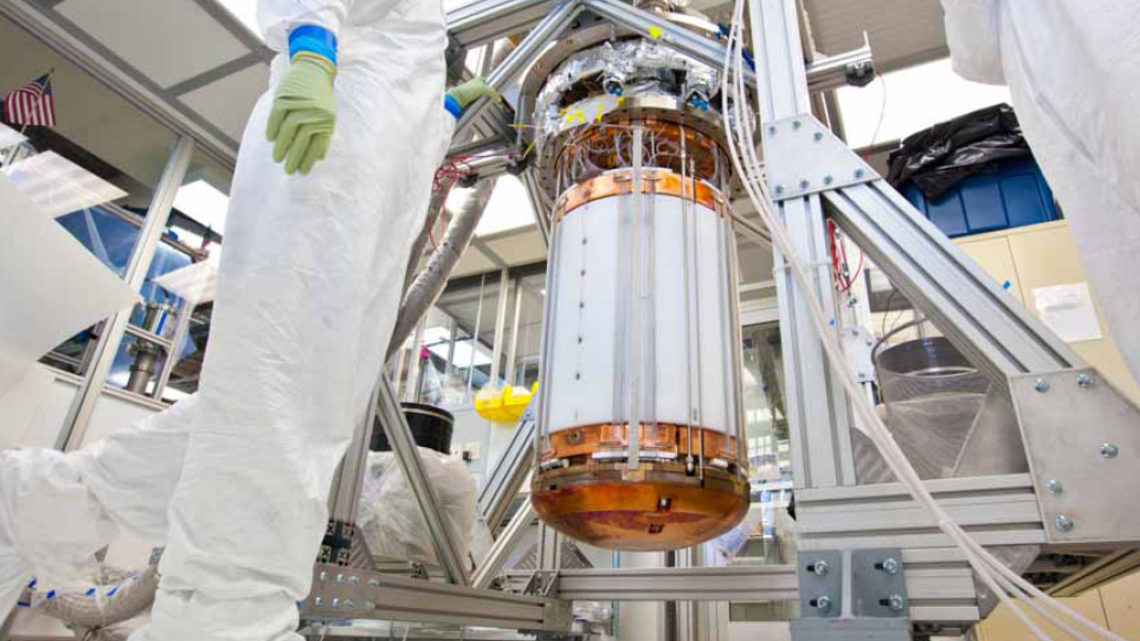
Dark matter constitutes approximately 85% of all matter in the universe, yet its fundamental nature remains one of the most profound mysteries in modern physics . Scientists have long inferred its existence through gravitational effects on galaxies and the evolution of the cosmos, but direct observation has proven extraordinarily challenging due to dark matter’s exceptionally weak interactions with ordinary matter. This invisible substance does not emit, absorb, or reflect light, making it effectively undetectable through conventional observational methods.
The search for dark matter has driven innovation across multiple scientific disciplines, from particle physics and cosmology to materials science and quantum engineering. Recent breakthroughs in detector design have opened new pathways for exploration, expanding the search into previously inaccessible mass ranges and interaction regimes. This article examines the next generation of dark matter detectors, highlighting novel approaches that promise to revolutionize our understanding of the universe’s hidden architecture.
The Fundamental Challenge of Dark Matter Detection
To appreciate the significance of next-generation detector designs, one must first understand the extraordinary difficulties inherent in detecting dark matter. The expected interaction rate in most dark matter detectors is less than one event per kilogram of detector material per year, while background radiation in ordinary laboratory conditions is millions of times higher . This stark contrast necessitates extremely sensitive instrumentation deployed in ultra-low background environments.
Modern direct detection experiments generally operate deep underground to shield against cosmic rays, utilize extensive passive shielding to block environmental radioactivity, and employ materials with exceptional radiopurity . The fundamental requirements for any dark matter direct detection experiment include:
A. Ultra-low background rates achieved through deep underground operation and stringent material screening.
B. Large exposure, defined as detector mass multiplied by observation time, to maximize the probability of capturing rare interaction events.
C. Low energy thresholds that allow sensitivity to lighter dark matter candidates, which produce smaller recoil energies.
D. Effective discrimination between genuine dark matter signals and background events, particularly the ability to distinguish nuclear recoils from electron recoils .
The physics community has pursued dark matter detection through various strategies, broadly categorized into direct detection (observing interactions in terrestrial detectors), indirect detection (observing annihilation or decay products in astrophysical settings), and collider production (creating dark matter particles in high-energy accelerators). This article focuses primarily on direct detection approaches, where the most dramatic technological advances have recently occurred.
Semiconductor Quantum Well Detectors: The SQWARE Approach
A particularly innovative proposal emerging from Rice University researchers introduces the Semiconductor Quantum Well Axion Radiometer Experiment (SQWARE), a detector design specifically optimized for hunting axions . Axions represent hypothetical particles that many physicists believe could constitute dark matter, originally proposed to resolve a fundamental problem in quantum chromodynamics.
The SQWARE design leverages sophisticated semiconductor materials whose electrical properties change predictably when their orientation shifts within a magnetic field . This property enables researchers to tune the detector without requiring complex mechanical adjustments, representing a significant advance over previous technologies. The detector utilizes stacks of ultrathin semiconductor layers known as multiple quantum wells, which confine electrons to flat, two-dimensional sheets.
When electrons become trapped in this manner, they behave collectively like a plasma, fundamentally altering how light propagates through the material. This plasma effectively provides photons with mass, an effect crucial for enabling the conversion of axions into detectable photons . In vacuum conditions, axions possess mass while photons do not, creating a momentum mismatch that impedes conversion. The semiconductor quantum well structure resolves this issue, enhancing the photon signal sufficiently for detection.
The researchers emphasize that while their study remains theoretical, they developed the design with practical constraints in mind, evaluating whether existing or near-term fabrication capabilities could produce the required semiconductor structures . The next critical step involves experimental validation of the predicted material performance in laboratory settings. The research team has initiated characterization studies of candidate semiconductor structures and is developing prototype devices for testing.
This approach demonstrates the productive convergence of condensed matter physics and particle physics, repurposing well-studied semiconductor materials for a fundamentally new application . The work highlights how advances in materials science can address some of the most fundamental questions in cosmology and particle physics.
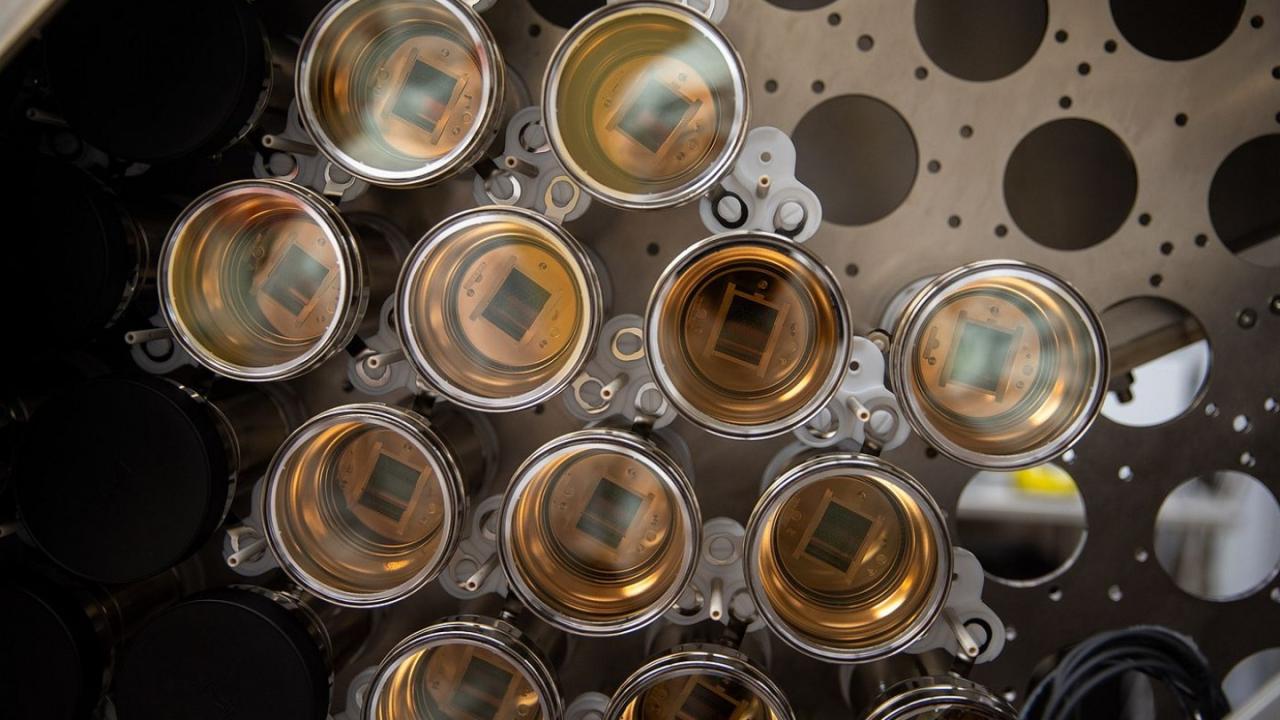
Disordered Dielectric Haloscopes: The DPHaSE Concept
Another innovative detector design, published in Physical Review D, proposes using disordered dielectric materials as conversion targets for light dark matter bosons such as axions and dark photons . This approach exploits the phenomenon of interface conversion, where dark matter particles convert to photons at material boundaries, generating detectable signals.
The proposed detector, called the Dielectric Powder Haloscope SNSPD Experiment (DPHaSE), consists of three main components:
A. A disordered dielectric target volume filled with dielectric powder, which provides extensive surface area for dark matter-to-photon conversion.
B. A photon collection chamber designed to maximize coupling between the powder target and detection systems.
C. A superconducting nanowire single photon detector (SNSPD) for extremely sensitive photon counting.
The disordered dielectric approach offers several compelling advantages. Unlike cavity-based haloscopes that resonate at specific frequencies, the broadband nature of interface conversion enables simultaneous sensitivity across a wide range of dark matter masses . This eliminates the need for time-consuming frequency scanning, potentially accelerating the search process significantly.
The researchers developed semi-analytical and numerical models of two-dimensional and three-dimensional disordered systems to calculate conversion power as a function of dark matter mass . Their projections indicate that with ambitious but realistic improvements to sensor area and detection efficiency at low energy, the detector could achieve sensitivity to QCD axion-photon couplings in the 10 meV to eV mass range, exceeding current constraints on dark photon dark matter by up to five orders of magnitude .
This design exemplifies a broader trend in dark matter physics: the shift from single-purpose, narrow-range detectors toward versatile, broadband instruments capable of exploring multiple candidate models and mass ranges simultaneously.
Scintillating Bubble Chambers: The SBC Collaboration
The Scintillating Bubble Chamber (SBC) collaboration is developing a fundamentally different approach to dark matter detection using liquid-noble bubble chambers capable of detecting sub-keV nuclear recoils . This technology enables searches for low-mass dark matter candidates and coherent elastic neutrino-nucleus scattering from low-energy neutrinos.
Scintillating bubble chambers offer unique advantages that distinguish them from other detection technologies. The scintillation signal provides precise energy reconstruction capabilities, complementing the bubble chamber’s natural insensitivity to electron recoils . This combination yields exceptional background rejection, as most environmental background events produce electron recoils rather than the nuclear recoils characteristic of dark matter interactions.
The collaboration is constructing two 10-kilogram detectors that are functionally identical. The SBC-LAr10, currently being commissioned at Fermilab, serves primarily as an engineering and calibration platform, while SBC-SNOLAB will operate at the deep underground SNOLAB facility for a low-background dark matter search . The high level of superheat achievable in noble liquids while maintaining electron-recoil insensitivity enables lower nuclear recoil thresholds than traditional freon-based bubble chambers, potentially reaching the 100 eV threshold required for reactor coherent elastic neutrino-nucleus scattering measurements .
This technology demonstrates how combining well-established principles—the bubble chamber concept pioneered in particle physics decades ago—with modern materials and readout techniques can yield new capabilities.
Cryogenic Calorimeters: The CRESST Upgrade
The Cryogenic Rare Event Search with Superconducting Thermometers (CRESST) experiment represents one of the longest-running direct detection efforts and is now undergoing a comprehensive upgrade to achieve unprecedented sensitivity to sub-GeV dark matter . The CRESST approach employs cryogenic calorimeters operated at approximately 15 millikelvin, using transition-edge sensors (TESs) to detect minute temperature changes resulting from particle interactions.
The upcoming CRESST upgrade will incorporate approximately 100 detectors with masses ranging from 2 grams to 24 grams, representing a significant expansion in exposure . The low thresholds achievable with this technology, as low as 6.7 eV for gram-scale detectors and 30.1 eV for 23.6-gram crystals, have already enabled CRESST to probe dark matter masses as low as 73 MeV/c² .
The upgrade introduces several innovations and confronts significant challenges:
A. The large number of low-temperature detectors with TESs and DC-SQUID readout introduces substantial complexity in setup and operation.
B. A reformulated data processing pipeline is being developed to handle the increased data rate and automate detector operational optimization through reinforcement learning .
C. Machine learning efforts are being applied to first-level quality cuts and live-time optimization .
D. Advanced simulation techniques are being adapted to model the entire setup efficiently while minimizing analysis time.
E. Approaches to address the low-energy excess background, a key limitation in previous and current sub-GeV dark matter searches, are being implemented through new detector layouts and dedicated measurement campaigns .
The CRESST technology’s flexibility in target material selection allows researchers to optimize sensitivity for different interaction models and dark matter candidates. The collaboration has employed various crystalline materials including Al₂O₃, CaWO₄, Si, and LiAlO₂, with each offering different advantages for spin-independent or spin-dependent interactions .
Quantum Sensing and Atom Interferometry
Recent advances in quantum technology have opened entirely new approaches to dark matter detection. UK researchers have demonstrated a prototype quantum sensor that validates key principles underlying next-generation atom interferometers . This work, published in Nature, shows how comparing two atom interferometers operated along a common baseline allows experimental noise to be effectively canceled, enabling signal recovery even when individual measurements are overwhelmed by noise.
The Atom Interferometer Observatory and Network (AION) collaboration plans to use quantum interference techniques to search for ultralight dark matter and detect gravitational waves in frequency ranges not covered by existing observatories . A 10-meter baseline detector is planned for operation at the University of Oxford, with data collection targeted for before 2030.
The quantum sensor works by creating a quantum superposition of atoms, forcing them to exist in two places simultaneously before bringing them back together. Tiny changes in their motion can then be measured with extraordinary precision. The differential approach of comparing two interferometers cancels common noise, allowing the detection of effects that would otherwise be lost .
The researchers deliberately introduced large amounts of additional phase noise to simulate realistic long-baseline conditions. Individually, each interferometer became unusable, its signal obscured by noise. However, when the two were compared, a clear signal could still be recovered, operating at the fundamental limit set by quantum physics . This experimental validation represents a crucial milestone for international quantum sensing efforts, with close partnerships with the MAGIS effort at Fermilab and proposals such as the Atom Interferometry CERN Experiment (AICE) .

Plasma Haloscopes: The ALPHA Experiment
The ALPHA collaboration represents another innovative approach to axion detection, breaking with decades of traditional haloscope design . The experiment employs copper plasma resonators immersed in a 9-tesla magnet, searching for axions with masses from 40 to 80 μeV in Phase I, with plans to expand to 80-200 μeV in Phase II .
The expected conversion power in ALPHA’s frequency range is approximately 10⁻²⁴ watts, comparable to thermal noise in a 50-ohm resistor cooled to 50 millikelvin . To detect such extraordinarily weak signals, the readout chain employs Josephson parametric amplifiers whose noise temperatures approach the standard quantum limit.
Several improvements are being developed for Phase II:
A. Quantum sensing techniques including noise squeezing, cavity entanglement, and state swapping.
B. Increased quality factors of superconducting plasma resonators to significantly boost the signal.
C. Larger-bore, higher-field magnets such as those being deployed at neutron scattering facilities, potentially expanding experimental reach up to 200 μeV and achieving sensitivity below the DFSZ axion-photon coupling benchmark .
The ALPHA experiment exemplifies how quantum metrology techniques developed in other contexts can be applied to fundamental physics questions, pushing detection sensitivity to the fundamental quantum limit.
Novel Materials: Bilayer Graphene Detectors
The use of novel materials for dark matter detection has gained increasing attention, with bilayer graphene emerging as a promising candidate for sub-MeV dark matter searches . Bilayer graphene’s voltage-tunable electronic band gap in the sub-eV range makes it an excellent choice for detecting light dark matter particles.
Research published in Physical Review D outlines a detector concept using bilayer graphene to detect sub-MeV dark matter through both electron scattering and dark matter absorption mechanisms . The material’s tunable threshold energy allows researchers to adjust sensitivity based on the theoretical parameters of the dark matter candidate being investigated.
A particularly intriguing feature of bilayer graphene detectors is the daily modulation of the dark matter scattering rate resulting from Earth’s rotation . This modulation provides a distinctive signature that could help distinguish genuine dark matter signals from backgrounds, a critical advantage in a field where background rejection remains paramount.
The projected sensitivity of bilayer graphene detectors competes favorably with other candidate target materials like superconductors, while offering the advantage of tunable threshold energy and intrinsic background discrimination capabilities . The research outlines a complete detector design concept with detailed noise estimates, providing a practical roadmap for future experimental implementation.
Liquid Xenon Time Projection Chambers: The XLZD Observatory
The XLZD (XENON-LZ-DARWIN) collaboration represents the next generation of liquid xenon time projection chamber technology, building on the success of current-generation experiments like LUX-ZEPLIN and XENONnT . The proposed detector features an active liquid xenon target of 60 tonnes, potentially expandable to 80 tonnes depending on market conditions.
The mature liquid xenon time projection chamber technology offers several compelling advantages:
A. Simultaneous detection of ionization and scintillation signals, enabling powerful background discrimination.
B. Scalability to large masses, providing the exposure necessary for rare event searches.
C. Excellent sensitivity to weakly interacting massive particles (WIMPs), the historically dominant theoretical candidate.
D. The ability to search for multiple physics phenomena including dark matter, neutrinoless double beta decay, and astrophysical neutrinos .
The projected sensitivity of XLZD extends to the so-called “neutrino fog,” where coherent neutrino-nucleus scattering becomes an irreducible background . At this fundamental limit, the experiment would have 3σ evidence potential for WIMP-nucleon cross sections as low as 3×10⁻⁴⁹ cm² at 40 GeV/c² WIMP mass. The observatory will also have leading sensitivity to alternative dark matter models and a projected 3σ observation potential of neutrinoless double beta decay of ¹³⁶Xe at a half-life of up to 5.7×10²⁷ years .
The XLZD design book represents the most comprehensive description of next-generation xenon technology, addressing baseline design and opportunities for optimization across individual detector components .
The Future Landscape of Dark Matter Detection
The diversity of approaches described here reflects the growing recognition that dark matter may manifest in forms beyond the traditional WIMP paradigm. The theoretical landscape has expanded dramatically, encompassing candidates spanning approximately 50 orders of magnitude in mass, from ultralight bosons at 10⁻²² eV to Planck-scale particles .
This expanding parameter space demands complementary detection strategies:
A. Semiconductor quantum well detectors optimized for axion searches in specific mass ranges .
B. Disordered dielectric haloscopes providing broadband sensitivity across multiple mass ranges .
C. Scintillating bubble chambers enabling low-threshold nuclear recoil detection .
D. Cryogenic calorimeters achieving exceptional energy resolution for sub-GeV searches .
E. Atom interferometers and quantum sensors probing ultralight dark matter through fundamentally different physical mechanisms .
F. Plasma haloscopes extending axion searches to higher frequencies .
G. Novel materials like bilayer graphene offering tunable detection thresholds .
H. Large liquid xenon observatories providing unprecedented sensitivity to conventional WIMP candidates .
The convergence of these diverse approaches represents one of the most exciting periods in the history of dark matter physics. The next several years will see the commissioning and operation of numerous next-generation experiments, dramatically expanding our ability to probe the dark universe.
Conclusion
The next generation of dark matter detectors embodies the creative synthesis of advances across multiple scientific and engineering disciplines. From semiconductor quantum wells to superconducting nanowires, from cryogenic calorimeters to atom interferometers, the technological diversity of these approaches reflects the complexity of the fundamental question they seek to address.
The research community has recognized that solving the dark matter mystery will likely require multiple complementary detection strategies, each optimized for different theoretical candidates and mass ranges. The recent innovations in detector design demonstrate remarkable creativity in adapting technologies developed for other purposes to the unique challenges of dark matter detection.
The combination of experimental sophistication, theoretical guidance, and technological innovation suggests that the next decade may finally provide the breakthrough that has eluded physicists for nearly a century. Whether the discovery reveals axions, WIMPs, dark photons, or an entirely unexpected form of matter, the journey of discovery continues to drive progress across the frontiers of physics.